Straatos is a digital infrastructure for environmental and outdoor projects. It supports the full lifecycle of climate action: from field data collection to credit issuance, ensuring that every data point is traceable, verifiable, and fair.
Teams managing nature-based carbon projects were juggling data across spreadsheets, paper field notes, satellite imagery, and disparate legacy systems. Field technicians in remote locations lacked tools that worked offline and matched their daily workflow.
Compliance with Verra methodologies like VM0033 required meticulous audit trails, weeks of manual reconciliation per project cycle, prone to errors, delaying critical verification milestones.
Straatos unifies field capture, project management, and verifier-ready reporting in a single digital workspace. Technicians record offline on tablet or mobile; once back online, data flows into structured, methodology-aware records.
Audit trails build themselves. Every entry carries provenance, timestamps, and the operator's identity, so verification becomes a review of what's already documented, not a forensic reconstruction.
Information Architecture
The platform lives in two modes. Application is the cross-project shell, analysis, modules and data that sit above any single project. Project is the working file, profile, preparation, plots, cycles, monitoring. Same sidebar, same hierarchy, different scope. The user never has to relearn where things are.
Design Principles
Users don't wake up thinking about VM0033. They need the platform to quietly translate their field data into compliant outputs, without requiring them to memorize the methodology's internals.
Testimonials from community members, often gathered in local languages, carried real weight in reports, yet most carbon tools treated them as an afterthought. I gave them first-class status.
The data gathered on the platform must be structured so every source, from Brazil to Japan, compiles the same way, online or offline, then flows into different methodologies and analyses.
Process · Swimlane
Four actors, five phases. The Platform sits as its own lane because it carries the data continuously between human handoffs, picking up offline captures, surfacing them upstream, and packaging everything for the verifier at the end.
Visual System
The Product
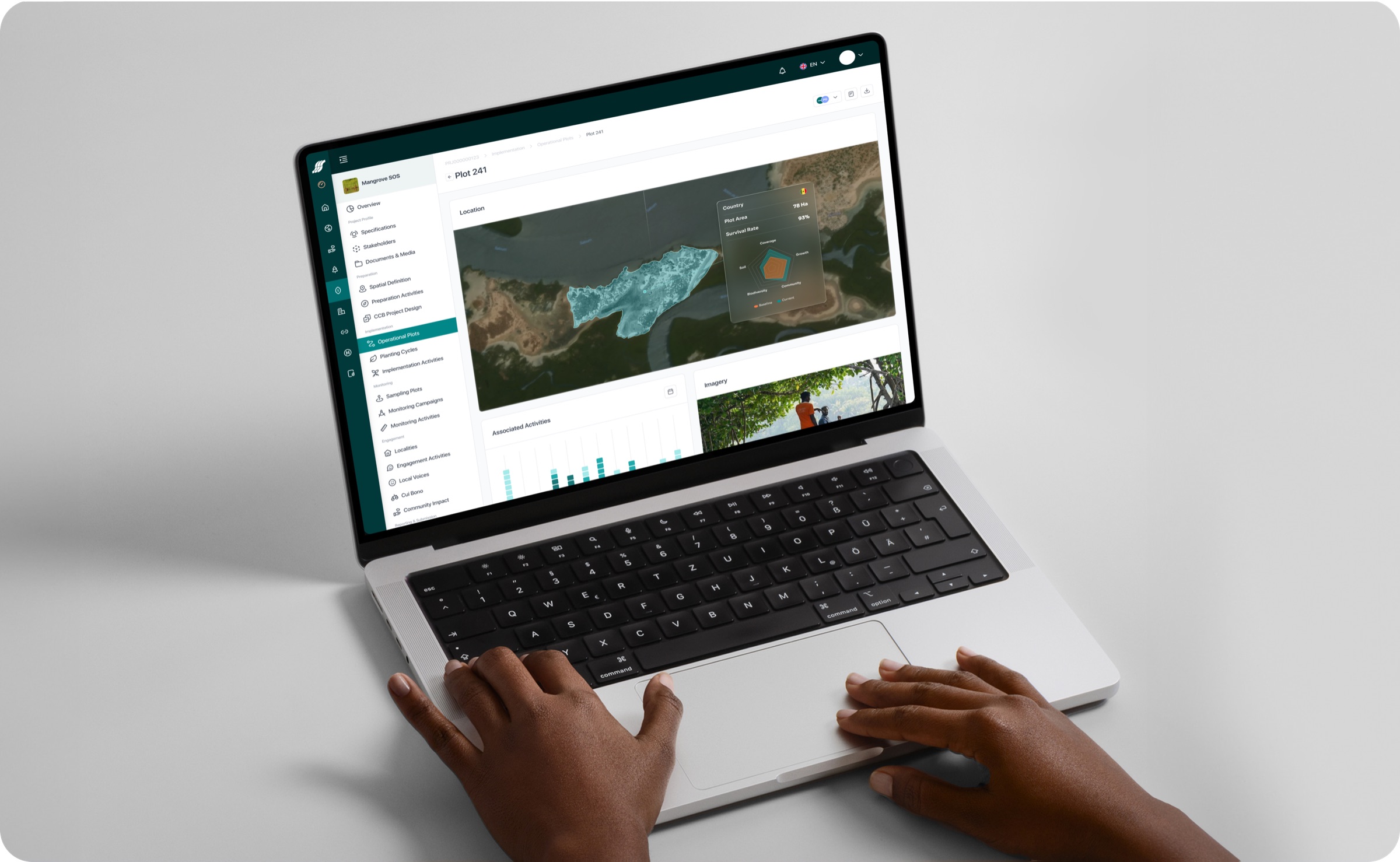
Five surfaces, one mental model. The dashboard anchors on a 3D globe, every project pinned in place. From there, project developers move into cycles and campaigns, satellite plot views, and finally simulations that forecast the same numbers the verifier will read at the end. No translation between screens; the data flows through one structure.